
Anúncios
Have you ever wondered what happens behind the scenes before an aircraft safely crosses oceans?
The success of these global operations depends directly on rigorous pilot training, transforming students into professionals capable of managing complex systems and making quick decisions under pressure.
Anúncios
Here, we explore how these specialists develop vital skills for efficiency on long-haul routes.
The fundamental role of pilot training in high-fidelity simulators.

Operational excellence in long-haul aviation begins long before takeoff, within highly sophisticated virtual cockpits.
The constant use of flight simulators allows professionals to hone their technical skills in a safe and controlled environment, essential for maintaining the required safety standards on international routes.
Anúncios
Total Immersion Technology
Modern equipment offers a total immersion experience that faithfully replicates real operating conditions.
Through high-definition visual systems and dynamic motion platforms, the pilot feels every maneuver as if they were in the real aircraft, helping to reduce adaptation time to new aircraft.
Furthermore, the technology allows the crew to practice complex procedures repeatedly until they achieve perfection. The focus is on ensuring that every movement is intuitive during the actual flight.
Complex and Unpredictable Scenarios
Preparation for long-haul aviation requires the pilot to be ready for any eventuality. Simulators allow the creation of complex and unpredictable scenarios, such as critical system failures or severe weather changes in the middle of the ocean.
When faced with these situations in a simulated environment, the pilot develops resilience and quick decision-making skills.
Continuous training on these devices is what guarantees the excellence and confidence necessary to handle the unexpected.
Fatigue Management and Circadian Rhythms
Operational fatigue represents one of the biggest obstacles to safety on long flights. When pilots cross multiple time zones, the human body faces significant challenges in adapting to new light and dark routines.
Effective management of these factors is an essential pillar to ensure that the crew maintains peak performance. Without due care, biological disorientation can compromise the necessary precision during air operations.
Understanding the Impact of Time Zones
Circadian rhythms function like an internal clock that regulates various biological functions, including the sleep-wake cycle. When this system is disrupted by rapid travel between continents, a mismatch occurs that directly affects cognitive ability.
This phenomenon, known as jet lag, can cause excessive sleepiness and reduced reaction speed. Understanding how the body processes these changes is the first step in mitigating negative effects in the work environment.
Strategies for maintaining alertness
To combat operational fatigue, pilots adopt techniques based on scientific evidence that help regulate the biological clock. Therefore, maintaining focus throughout the workday is a shared responsibility that requires discipline and rigorous planning.
Some fundamental practices include:
- Gradual adjustment of sleep schedule before departure to align the body with the destination.
- Strategic exposure to natural light to help regulate circadian rhythms.
- Controlled caffeine consumption at specific times to avoid energy spikes followed by sharp drops.
- Taking short, planned breaks for rest during the flight.
- Maintaining a consistent hydration routine to aid metabolic function.
Crew Resource Management (CRM) techniques in cockpits.
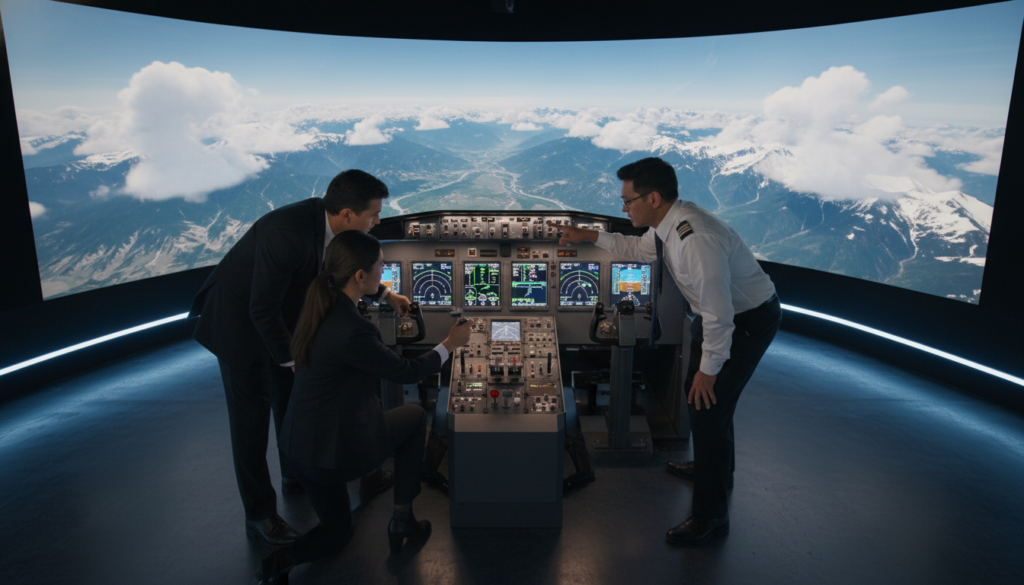
The success of a long-haul flight begins long before takeoff, in how the crew interacts.
CRM in aviation is a set of vital skills that ensures all cabin crew members work in sync, transforming the work environment into a collaborative and highly efficient system.
Assertive communication among the crew
Clear communication is the foundation for any safe air operation. When pilots use direct and objective language, the chances of misunderstandings decrease drastically during the flight.
Maintaining a constant flow of information allows everyone to know exactly what is happening with the aircraft, strengthening mutual trust among crew members.
The use of CRM in aviation helps eliminate hierarchical barriers that could prevent someone from reporting an important problem.
Team decision-making under pressure
Unexpected situations can arise at any time, requiring quick and accurate responses. In these moments, the ability to decide together is what separates a smooth operation from a critical error.
Harmonious collaboration allows the team to assess risks in a balanced way, even under intense stress.
By dividing the workload, pilots can maintain focus on what truly matters for flight safety, ensuring that the aircraft always remains under control, regardless of the challenges encountered along the way.
Emergency Procedures Training for Transoceanic Flights
When we are thousands of kilometers from any runway, emergency procedures training becomes our greatest ally.
Flying over vast ocean expanses requires a level of technical preparedness that goes far beyond the basics, ensuring that the crew knows exactly how to act in critical situations.
Air safety is maintained through rigorous planning and mastery of techniques that allow for flight continuity or safe diversion.
Route Deviation Protocols
Route deviation protocols are designed to offer safe options when the original destination is no longer viable.
The crew constantly assesses the aircraft’s position relative to the nearest alternate airports, considering fuel consumption and weather conditions.
This decision-making process needs to be quick and precise, with the primary focus always being to guarantee the safety of everyone on board, following international guidelines that standardize communication with air traffic control centers.
Dealing with technical failures far from airports
Dealing with technical failures in the middle of the ocean is one of the greatest challenges faced by pilots. Training focuses on remaining calm and following rigorous checklists to isolate the problem and protect the aircraft.
Even without nearby support airports, current technology and crew preparedness allow for the efficient management of complex failures. The priority is always to stabilize the flight and find the safest solution to successfully complete the journey.
Conclusion

Success in an aviator’s career demands a constant combination of technique, physical health, and mental preparedness.
The pursuit of an up-to-date pilot training guide allows professionals to reach new levels of competence. Every flight hour is an opportunity to refine skills and ensure air safety at every stage of the journey.
The conscious use of CRM in aviation strengthens crew bonds, enabling quick and accurate decisions under pressure, and is the pillar that sustains passenger confidence on transoceanic routes.
Maintaining focus during long journeys depends directly on managing personal well-being. Strategic rest acts as a vital tool to preserve alertness and the cognitive clarity necessary for command.