
Anúncios
Have you ever wondered if there’s a route in the sky that offers more peace of mind during an international trip?
The truth is, the airline industry invests heavily in technology to ensure maximum passenger safety on all routes. Understanding the technical protocols helps demystify flying and allows you to enjoy the journey with much more peace of mind.
Anúncios
Today, we’ll discover everything about how to find the safest route to fly.
The technology behind the safest route
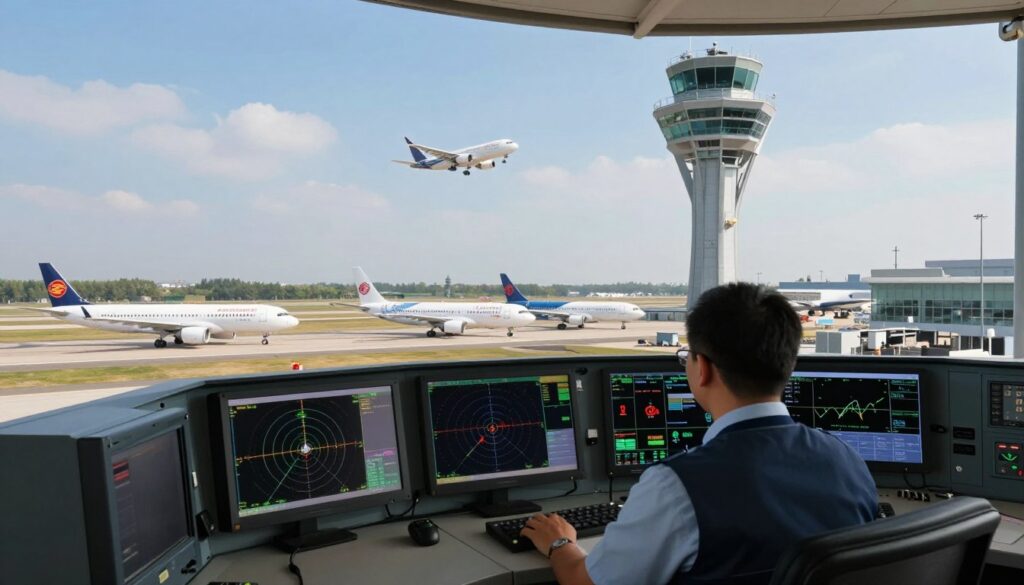
Modern air safety relies on an invisible data network connecting aircraft and the ground.
Thanks to constant advances in flight technology, it is now possible to track aircraft with millimeter precision, whether they are flying over oceans or isolated continents.
Anúncios
This advanced connectivity allows control centers to know exactly where each aircraft is, which is fundamental to raising safety standards to unprecedented levels, ensuring smoother journeys for all passengers.
Satellite Navigation Systems
Current air navigation uses satellite constellations to determine the exact position of an aircraft in real time, replacing older methods and offering precision that directly assists in calculating more efficient and safer routes.
Real-time Aircraft Monitoring
Aircraft monitoring occurs continuously, allowing air traffic controllers to track every movement, helping to avoid traffic conflicts and optimize flight flow in busy air corridors.
The Role of Modern Transponders
Transponders are key pieces in this mechanism, sending vital data on altitude, speed, and identification.
By integrating this flight technology with ground systems, air navigation becomes much more robust, ensuring that safety standards are maintained and allowing for constant and efficient surveillance of aircraft monitoring across the globe.
The role of air traffic control and infrastructure
Behind every smooth flight lies a complex system of control and infrastructure. Air traffic control acts as an invisible network that organizes the flow of aircraft, ensuring that each aircraft maintains a safe distance throughout its journey.
This organization is essential for air safety, preventing conflicts and allowing the sky to be an orderly environment. Without this constant support, navigation in busy airspaces would be impossible.
Collaboration between global control centers
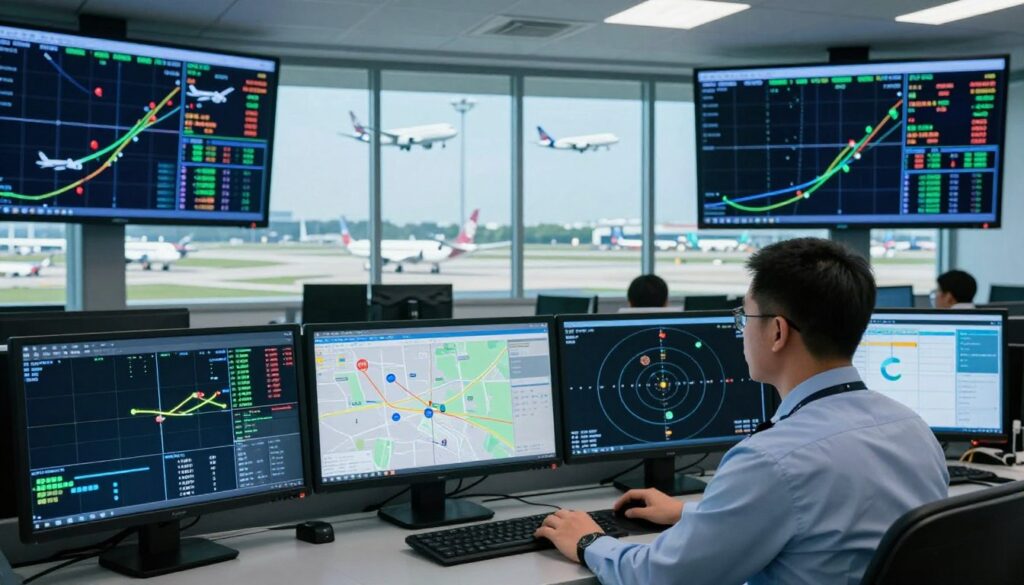
Modern airspace management depends on cooperation between different control centers around the world. When an aircraft crosses borders, the responsibility for monitoring aircraft is seamlessly transferred between control towers.
This exchange of information ensures that air traffic control has a clear view of all routes. Technology allows controllers on different continents to align their flight plans, maintaining high levels of efficiency and air safety.
Runway and Visual Aid Maintenance
Beyond what happens in the sky, airport infrastructure plays a fundamental role in the success of every operation.
Well-maintained runways and precise lighting systems are vital for pilots to perform landings and takeoffs with complete confidence.
Visual aids, such as approach lights and ground markings, serve as essential guides in low visibility conditions.
Therefore, investing in the constant maintenance of these elements ensures that airport infrastructure can support the intense flow of passengers with maximum precision.
How Airlines Choose Their Routes
Behind the scenes of civil aviation, route planning is a precise and strategic science. Airlines carry out detailed planning for each journey, considering available airport infrastructure and prevailing operational conditions.
The main objective is always to guarantee the safety of everyone on board, prioritizing passenger well-being above any financial savings.
Fuel Optimization and Safety
The balance between fuel efficiency and safety is at the heart of flight planning, using advanced software to calculate trajectories that reduce consumption without compromising necessary reserve margins.
This intelligent management allows aircraft to operate with greater autonomy. At the same time, constant air traffic control support ensures that the chosen route is as smooth as possible.
Avoiding Conflict and Instability Zones
Safety in international flights depends on the ability to adapt quickly to global scenarios. Airlines constantly monitor areas of political instability or geopolitical tensions to proactively divert their routes.
Beyond conflicts, climate monitoring is essential to avoid areas of severe turbulence or storms. By bypassing these regions, companies ensure that the route remains safe and comfortable for all travelers.
Meteorological Factors and Risk Management
Air safety depends on our ability to predict atmospheric behavior. Aeronautical meteorology acts as one of the most critical pillars for the success of any operation, allowing us to anticipate phenomena even before they become visible to the human eye.
By understanding the types of weather conditions, companies can raise the level of passenger protection, which is essential for efficient risk management, ensuring that the route is planned based on accurate and up-to-date data.
Turbulence Detection Technologies
Modern flight technology allows aircraft to identify areas of instability in advance.
Advanced sensors and state-of-the-art weather radars provide pilots with a clear view of what lies ahead, even in seemingly clear skies.
These systems are vital to avoid discomfort and ensure the structural integrity of the aircraft. With the aid of these tools, the crew can proactively adjust altitude or route, keeping safety as an absolute priority.
How pilots navigate severe storms
When severe storms arise, the pilots’ experience combined with flight technology makes all the difference, using heat maps and satellite imagery to identify the core of the storms and deviate precisely.
This maneuver is performed smoothly, minimizing the impact on those on board, with the goal of always keeping the aircraft away from areas of high turbulence or hail, ensuring a smooth flight.
Constant communication with meteorology
Risk management also depends on an uninterrupted flow of information between the cockpit and ground control centers. Constant communication with aeronautical meteorology allows the crew to make quick and effective decisions in the face of sudden changes in the weather.
This continuous dialogue ensures that the flight plan is adapted in real time. Thus, every decision made in the air reflects an unwavering commitment to the safety of everyone involved in the operation.
Conclusion
Safety in modern aviation stems from a perfect union between advanced technology, global infrastructure, and precise human decisions. Each flight represents a collective effort to ensure passengers arrive at their destinations safely.
Mastery of aeronautical meteorology allows pilots and controllers to anticipate weather changes with precision, transforming natural challenges into fully manageable situations within the cockpit.
Traveling through the skies today is a more reliable process than at any other time in history. The global system prioritizes the physical integrity of everyone involved at every stage of the journey.