Anúncios
Many people view air travel mishaps simply as part of the journey, but understanding the financial compensation available for issues on international flights can completely change that perspective.
Delays, cancellations, denied boarding, or missed connections carry distinct legal implications, depending on local regulations and applicable international treaties.
Anúncios
Today, we will explore how to assess each situation and ensure you receive the necessary support during your travels around the world.
When a flight issue may entitle you to financial compensation

Knowing how to identify when an issue at the airport turns into an opportunity for compensation is essential for any traveler.
Not every unforeseen event guarantees a payout, but understanding the basic rules helps protect your interests during international travel.
Anúncios
There are specific situations where the law requires an airline to provide financial compensation. The primary focus should always be on the impact the issue had on your journey and whether the airline fulfilled its obligations to provide assistance.
Prolonged delays and missing important commitments
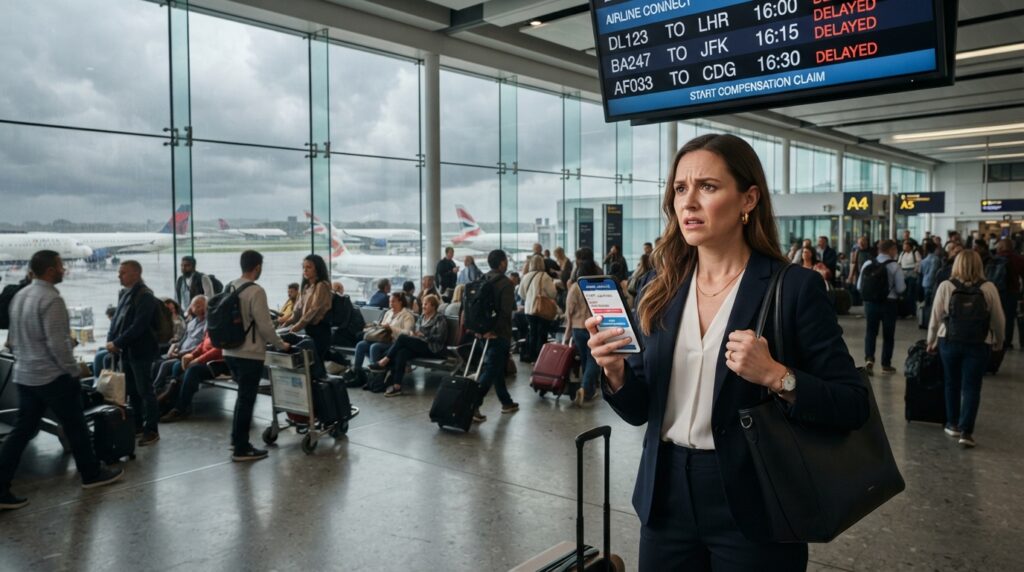
A delay on an international flight becomes much more significant when the wait time exceeds reasonable limits. The impact is even greater if the delay causes you to miss a business meeting, a planned event, or a pre-paid hotel reservation.
In such cases, compensation for a flight delay serves to mitigate the damages caused by a failure in service delivery. It is crucial to document all provable losses to strengthen your claim for compensation.
Last-minute cancellations
When an international flight is canceled without prior notice, the passenger is left in a vulnerable position.
While the airline is obligated to offer alternatives, this does not preclude the possibility of seeking compensation for the flight cancellation.
It is important to assess whether the alternative offered by the airline truly meets your original needs. Often, a newly proposed itinerary can create further complications, which should also be taken into account when evaluating your case.
Denied boarding due to overbooking
Denied boarding due to “overbooking” occurs when an airline sells more tickets than the aircraft’s actual capacity. This business practice grants immediate rights to any passenger who is prevented from traveling as planned.
If you encounter this situation, you should verify whether the airline provided the necessary support, such as immediate rebooking or material assistance. Documenting the incident is essential to ensure that compensation for a flight cancellation or denied boarding is properly processed.
Significant changes to the schedule, route, or airport
Substantial alterations to the agreed-upon itinerary may be treated as a cancellation or a serious delay. Therefore, to determine whether you are entitled to compensation for a flight delay, always compare your original ticket with the service that was actually provided.
- Schedule changes that result in missed connections.
- Airport changes that incur additional travel costs.
- Route changes that drastically increase total travel time.
- Aircraft changes that result in a lower class of service than the one booked.
International rules that can protect passengers
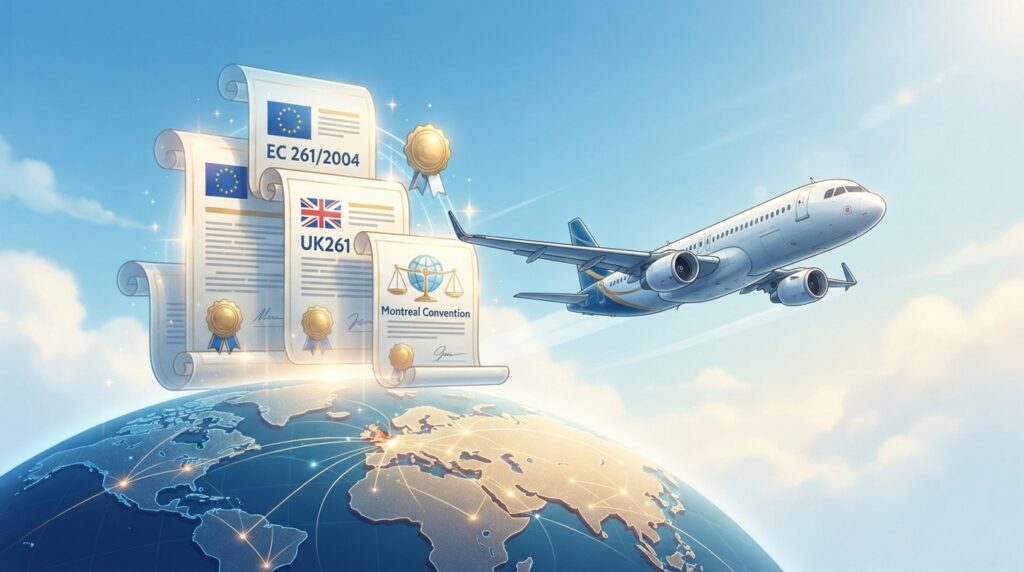
Did you know that there are international standards in place to safeguard your financial security when traveling?
When you encounter issues on international flights, it is crucial to understand that different laws may apply, depending on the route and the airline you have chosen.
Being aware of these mechanisms can help turn a frustrating experience into one where your rights are upheld.
European Regulation EC 261/2004 and the flights it covers
European Regulation EC 261/2004 is one of the most robust instruments for protecting travelers. It applies to flights departing from airports located within the European Union, regardless of the airline’s nationality.
Furthermore, it also covers flights arriving at these destinations, provided they are operated by European airlines. This regulation offers solid protection in cases of delays, cancellations, and denied boarding.
UK261 and situations involving the United Kingdom
Following significant changes in the European landscape, the United Kingdom adopted its own set of regulations, known as UK261. While very similar to the European model, it operates independently to address specific situations that occur within British territory.
If your flight involves the United Kingdom, it is essential to determine whether this local legislation is the most applicable to your situation. UK261 ensures that passengers retain rights similar to those that previously existed in the region.
The Montreal Convention for provable losses
Unlike regulations that provide for fixed compensation, the Montreal Convention focuses on the reparation of actual damages. It is frequently used to cover provable losses, such as additional expenses for accommodation, meals, or lost luggage.
This international treaty establishes limits on airline liability for flights between signatory countries. It serves as a powerful tool for seeking reimbursement for costs you incurred due to failures in the provision of services.
Transport conditions and regulations of the countries involved in your trip
In addition to global treaties, each country has its own transport conditions that govern the contract between the passenger and the airline. These local regulations may offer additional layers of protection or define specific procedures for filing complaints.
It is always worth consulting the contract of carriage provided by the airline at the time of purchase.
Combining these local rules with international treaties is the best strategy to ensure you receive the necessary assistance throughout your journey.
How to determine which legislation applies to your itinerary
Did you know that the legislation applicable to international flights can change depending on where you depart from or the nationality of the airline?
Departure, destination, and connecting airports
The point of departure and the final destination are the pillars that define which regulations protect the passenger. Often, the connecting airport also plays a crucial role in determining the applicable jurisdiction.
- Geographical location of the departure airport.
- Country of the trip’s final destination.
- Specific regulations of the territory where a layover takes place.
- International treaties signed by the countries involved.
European, British, or other jurisdiction-based airlines
The nationality of the air carrier is a key factor in determining which specific regulations apply. Airlines based in the European Union or the United Kingdom, for example, follow strict standards that benefit passengers, regardless of the flight’s origin.
If an airline is not European, the level of protection may depend entirely on the departure airport. Therefore, reviewing your contract of carriage is an essential step before filing any claim.
Single tickets, separate bookings, and missed connections
How you purchased your tickets significantly affects the airline’s liability in the event of a missed connection due to a delay. When all segments are included on a single ticket, the airline is responsible for ensuring you reach your final destination.
Conversely, with separate bookings, each segment is treated as an independent contract. This means that if the first flight is delayed and you miss the second, the airline operating the first leg may not be obligated to cover the costs of rebooking you for the subsequent leg.
Why the same delay can lead to different outcomes on different routes
An identical delay—in terms of minutes—can result in different rights, as the level of protection depends on a combination of jurisdiction, the air carrier, and how the booking is structured.
What qualifies for compensation on one route may not suffice on another, due to variations in local laws.
Always evaluate your specific situation to determine whether a missed connection caused by a delay falls under the applicable regulations.
Staying well-informed about the laws governing international flights is the best way to protect your interests as a traveler.
Conclusion
The journey toward obtaining fair redress requires patience and organization. Success in seeking financial compensation depends on a precise combination of factors: the nature of the incident, the course of action chosen, the airline involved, and the legislation applicable to your specific case.
Understanding your rights as an air passenger can turn a frustrating experience into an opportunity to claim what you are rightfully owed. Therefore, gather all relevant documents, record every detail of what occurred, and maintain a clear log of your interactions with the airline.
Always request a formal, reasoned response before accepting any immediate offer or voucher. Evaluating the proposed terms ensures you do not inadvertently waive more substantial benefits guaranteed by international regulations.