
Anúncios
Have you ever stopped to consider what it would be like to land on a runway surrounded by crystal-clear waters or perched atop a steep cliff? Modern engineering often defies logic to connect remote destinations, creating true works of aviation art.
Exploring these locations means immersing yourself in settings where nature and technology meet in surprising ways. Many of these terminals arose from the human need to overcome geographical barriers that seemed insurmountable just a few decades ago.
Anúncios
Today, we’ll take a look at some of the exotic airports that captivate travelers around the globe.
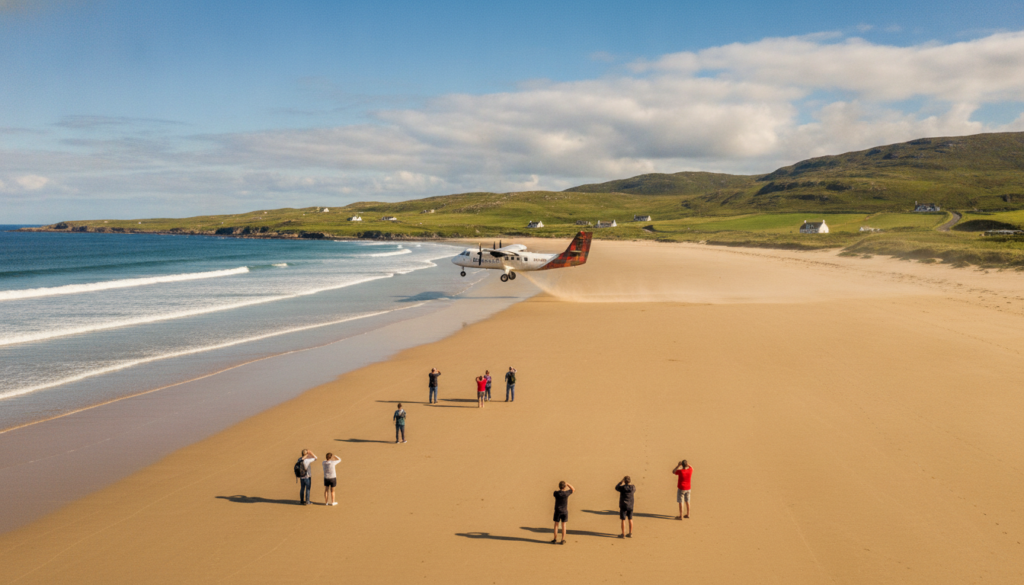
Barra Airport (Scotland): Landing on the beach sand

On the remote Scottish island of Barra, nature dictates the rules of aviation—a fascinating example of how engineering can adapt to the environment to maintain essential air routes in isolated areas.
The airport is world-renowned for being the only one where commercial aircraft land directly on the beach sand. This unique feature places it at the top of the list of destinations for travelers seeking offbeat adventures.
Anúncios
The unique experience of a natural runway
The sensation of arriving in Barra is unforgettable, as the plane touches the sandy ground with surprising smoothness. Unlike concrete runways, the sand offers a distinct texture that makes every landing a memorable event for passengers.
Although the concept might seem risky to some, local pilots undergo rigorous training to handle this surface, approaching these challenging landings with a composure that reassures anyone watching from the window.
How the tide dictates flight schedules
Airport operations depend entirely on the tidal cycle. At high tide, seawater completely covers the runway, making any flight operations impossible.
Consequently, flight schedules are adjusted daily based on the ocean’s movements. This constant reliance on nature turns transport logistics into a true ballet between human technology and the power of the water.
Lukla Airport (Nepal): A challenge in the high Himalayas
Situated high in the Himalayas, Lukla Airport represents the pinnacle of adventure travel for many mountaineers. Often cited as one of the most complex airports in the world, it demands impeccable technical skill from all professionals operating in the region.
Its strategic location at the foot of Mount Everest attracts explorers from across the globe seeking unforgettable expeditions; however, they must face the reality of an extremely short, steeply inclined runway that ends abruptly at a precipice. The Gateway to Mount Everest
For those planning to climb Earth’s highest peak, Lukla is the essential starting point. The airport serves as a vital gateway, connecting civilization to the heart of the frozen mountains.
The adventure begins long before the final ascent—the moment the landing gear touches Nepalese soil. It is an intense experience that demands courage, turning the arrival into a memorable story for any traveler.
Weather Conditions and Pilot Expertise
Those familiar with the region treat the Himalayas’ volatile weather conditions with the respect they deserve. Safety is the top priority, and pilots face constant challenges due to rapidly changing visibility and strong winds.
Pilots must deal with complex variables to ensure a safe landing. Among the main obstacles faced daily, we highlight:
- The steep slope of the runway, which requires precise braking.
- The constant presence of fog, which reduces visibility.
- Mountain winds that affect the aircraft’s stability.
- The short length of the runway, which limits the margin for error.
- The need for rapid maneuvers between rocky peaks.
Therefore, mastering these dangerous landings is an art that few can execute with true skill.
The combination of specialized training and deep knowledge of the terrain makes the piloting challenges at Lukla a fascinating example of human achievement.
Courchevel Airport (France): Sloped runways in the Alps
Imagine landing on a runway that resembles a ski slope in the heart of the French Alps.
Courchevel Airport is one of the most striking examples of unique airports, serving as the gateway to luxury tourism at one of Europe’s most prestigious ski resorts.
Its geographical location creates unique conditions that turn a simple arrival into an unforgettable adventure. Access to this remote destination is made possible by infrastructure that defies the mountainous terrain itself.
The adrenaline of landing on a ski slope
The Courchevel runway is famous for being one of the steepest short runways in the world. Due to the sharp incline, landing requires the pilot to use the natural upward slope of the terrain to slow the aircraft down.
This technical maneuver delivers an unparalleled adrenaline rush for passengers.
Safety and specialized pilot training
Given the complexity of the terrain, piloting challenges are constant and demand a high level of expertise. Only pilots holding a specific certification for this runway are permitted to perform takeoffs and landings there.
Training focuses on precision maneuvers and rigorous aircraft control amidst changing weather conditions. Therefore, to ensure everyone’s safety, the airport follows strict protocols that include:
- Requirement for a special license for landings on sloped runways.
- Constant monitoring of visibility conditions in the Alps.
- Use of light aircraft adapted for short distances.
- Intensive training in high-fidelity flight simulators.
Princess Juliana Airport (St. Maarten): Extreme proximity to the sea
Princess Juliana Airport is a unique destination that defies the usual logic of civil aviation. Located on the island of St. Maarten, this airport has become a must-visit spot for aviation enthusiasts and thrill-seekers alike.
The location’s fame has skyrocketed in the social media era, with videos of planes flying just overhead at Maho Beach frequently going viral. What was once merely a standard landing route has transformed into a major attraction that drives the local economy.
A visual spectacle for beachgoers
For visitors to Maho Beach, the experience is unforgettable. Beachgoers can see the underbellies of large aircraft at extremely low altitudes during their final approach.
This direct visual contact creates a sense of proximity found nowhere else on the planet; it is common to see tourists poised with cameras, eagerly awaiting the moment the roar of engines drowns out the sea breeze.
The risks and global fame of the approach
Despite being one of the world’s most sought-after airports, operations here demand absolute caution. The proximity to the sand presents significant technical challenges for pilots, who must adhere to strict navigation protocols.
Modern civil aviation manages this unusual coexistence through clear signage and safety warnings posted along the beach.
Respecting designated areas is crucial to ensuring that this spectacle remains a safe experience for everyone involved.
Conclusion

Exploring these locations reveals the human capacity to overcome geographical barriers. Modern engineering transforms natural challenges into essential global connection points.
These famous airports demonstrate how human creativity shapes our planet. Each runway tells a story of technical achievement and strategic vision.
Transport infrastructure constantly evolves to ensure passenger safety. Observing these structures, therefore, offers insight into the effort required to maintain the global flow of people.