
Anúncios
Have you ever wondered what it would be like to travel at supersonic speeds again, like in the Concorde era? Supersonic aviation has the potential to revolutionize air travel, significantly reducing flight times.
Advanced aviation technology is bringing back the possibility of commercial supersonic flights. A startup is preparing for the return of supersonic aircraft with orders for more than 130 aircraft, as reported in an Exame article.
Anúncios
Today, we will learn more about the future of commercial supersonic aircraft.
The golden age of supersonic flights: the legacy of the Concorde
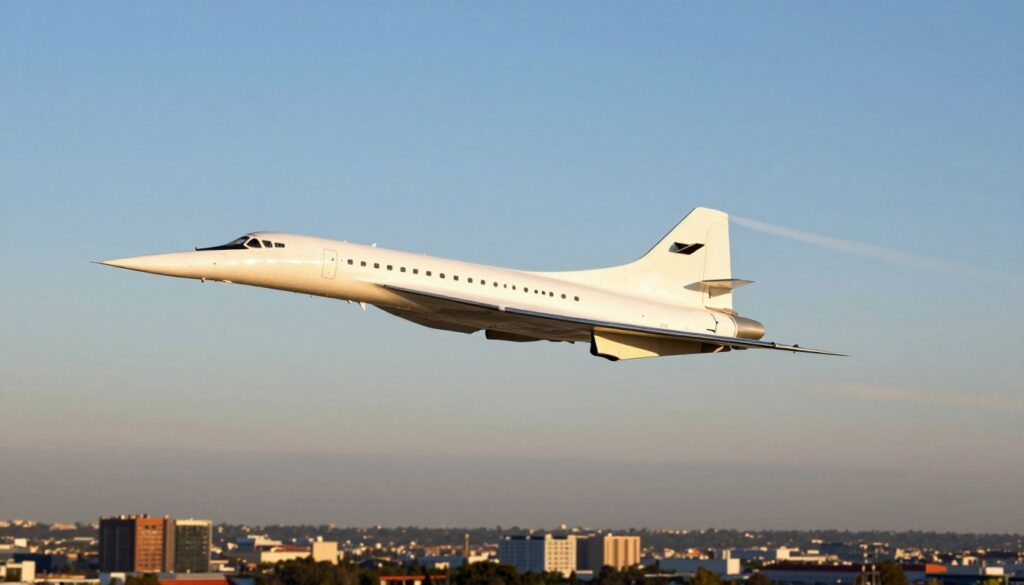
The Concorde, an icon of supersonic aviation, revolutionized the way we travel, marking a milestone in commercial aviation by offering speeds exceeding Mach 2.
The Concorde’s pioneering role in commercial aviation
The Concorde was the world’s first supersonic commercial aircraft, the result of a collaboration between British and French manufacturers. Its market introduction in 1976 marked the beginning of a new era in aviation.
Anúncios
The Concorde was capable of flying at speeds of up to Mach 2.04 (2,180 km/h), more than twice the speed of sound, allowing passengers to travel from London to New York in less than 3.5 hours.
Why the Concorde was retired
The retirement of the Concorde in 2003 was the result of a combination of factors.
Economic factors and the 2000 accident
One of the main reasons was the increase in maintenance and operating costs. Furthermore, a fatal accident in 2000 involving an Air France Concorde significantly affected public confidence.
Technological limitations of the time
The technological limitations of the time also played a significant role. The Concorde was fuel-intensive and had route restrictions due to the impact of the sonic boom.
The combination of these factors made Concorde operation unsustainable, leading to its decommissioning.
Commercial Supersonic Aircraft: Current Overview and Prospects
Technological advancements in recent decades have been crucial for the development of commercial supersonic aircraft. These advancements have not only improved aircraft efficiency but have also made the idea of traveling at supersonic speeds commercially viable.
Technological Advancements in Recent Decades
Aviation technology has evolved significantly, allowing for the development of more efficient and safer aircraft. Innovations in materials and aerodynamic designs have been fundamental to this evolution.
New Materials and Aerodynamic Design
The use of new materials, such as carbon composites and advanced metal alloys, has enabled the construction of lighter and stronger aircraft. Furthermore, innovative aerodynamic designs aim to reduce drag and increase efficiency.
Carbon Composites and Advanced Metal Alloys
Carbon composites are widely used due to their high strength and low weight. Advanced metal alloys also offer improved properties, such as corrosion resistance and durability.
Low-Drag, High-Efficiency Designs
Modern aerodynamic designs are engineered to minimize drag, allowing commercial supersonic aircraft to fly more efficiently, including optimizing aircraft shapes and reducing turbulence.
Here are some of the key benefits of technological advancements in supersonic aviation:
- Improved fuel efficiency
- Reduced environmental impact
- Increased safety
- Ability to fly at supersonic speeds sustainably
The challenges of modern supersonic aviation.
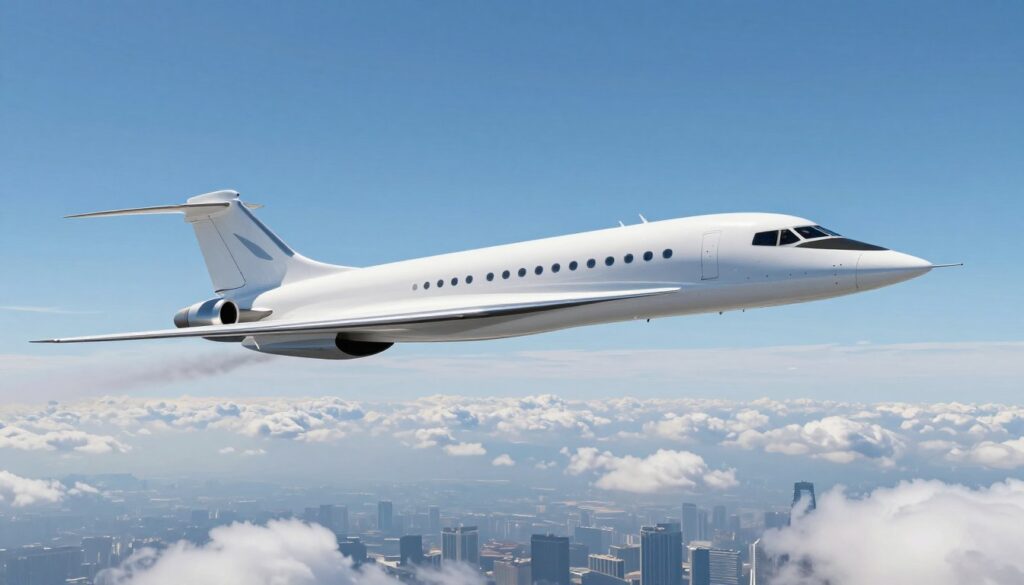
Modern supersonic aviation faces a number of technical and economic challenges that need to be overcome to make commercial supersonic flight a viable reality.
The problem of sonic booms
One of the main challenges is the sonic boom, a noise caused by the shock wave when an aircraft breaks the sound barrier, causing not only discomfort but also raising environmental and regulatory concerns.
- Development of technologies to reduce the sonic boom
- Government regulations on permitted noise levels
- Impact on the population in areas overflown
Fuel Efficiency and Energy Consumption
Fuel efficiency is important for the viability of supersonic aircraft. More efficient engines and aerodynamic designs are needed to reduce fuel consumption and minimize environmental impact.
- Development of more efficient engines
- Optimization of aerodynamic design
- Use of lightweight and resistant materials
Economic Viability and Operational Costs
The economic viability of supersonic aircraft depends on several factors, including operational costs and market demand. Therefore, reducing maintenance and operating costs is essential.
Supersonic Aircraft Maintenance
Maintenance of supersonic aircraft is more complex due to high speeds and thermal stresses. Specialized training and equipment are required.
Revolutionary Technologies in New Supersonic Aircraft
ASupersonic aviation is on the verge of a technological revolution, with several innovations being implemented to make flights faster and more sustainable, promising not only to improve the efficiency and performance of supersonic aircraft, but also aiming to reduce environmental impact.
Noise Reduction and Sonic Boom Mitigation Systems
One of the main challenges of supersonic aviation is the sonic boom, the noise produced when an aircraft breaks the sound barrier.
To overcome this problem, manufacturers are developing noise reduction systems and technologies to minimize the impact of the sonic boom. These innovations include advanced aerodynamic designs and materials that help reduce noise.
Sustainable Fuels for Supersonic Flights
Sustainability is a growing priority in modern aviation, and supersonic aircraft are no exception.
Manufacturers are exploring the use of sustainable fuels, such as biofuels and synthetic fuels, which can significantly reduce carbon emissions and other pollutants.
Advances in Aerodynamics and Propulsion
Aerodynamics and propulsion are critical areas for supersonic aviation. Advances include more efficient engines and aerodynamic designs that minimize air resistance, improving fuel efficiency and overall aircraft performance.
Low-Emission Engines
The engines of new supersonic aircraft are being designed to be cleaner and more efficient, including the adoption of technologies that reduce pollutant emissions, such as nitrogen oxides and fine particles, contributing to more sustainable aviation.
Advanced Flight Control Systems
Advanced flight control systems are essential for the safe and efficient operation of supersonic aircraft. These systems utilize cutting-edge technologies, such as fly-by-wire and computerized flight control, to improve aircraft maneuverability and stability.
The environmental impact of commercial supersonic aircraft.
As commercial supersonic aviation advances, it is crucial to assess its environmental implications. Supersonic aircraft have the potential to revolutionize commercial aviation, but it is important to understand and mitigate their impact on the environment.
High-altitude emissions and effects on the ozone layer
Supersonic aircraft fly at significantly higher altitudes than subsonic commercial aircraft, raising concerns about high-altitude emissions and their effects on the ozone layer.
Studies indicate that nitrogen oxide (NOx) emissions at high altitudes can contribute to the destruction of the ozone layer, making further research essential to fully understand these effects and develop strategies to minimize them.
Carbon footprint compared to subsonic aviation
The carbon footprint of supersonic aircraft is another critical aspect to consider. Even though supersonic aircraft are more time-efficient, their fuel consumption per passenger is generally higher than subsonic aircraft.
Initiatives to make supersonic aviation more sustainable
To mitigate the environmental impact, several initiatives are being developed. Some of these include:
- Development of sustainable aviation fuels.
- Optimization of aerodynamic design to reduce fuel consumption.
- Research into more efficient propulsion technologies.
Research into Alternative Fuels
One of the most promising research areas is the development of alternative fuels for supersonic aviation, with the potential to significantly reduce greenhouse gas emissions and other pollutants.
Companies and research institutions are working together to develop and test these fuels, aiming to make supersonic aviation more sustainable.
Conclusion
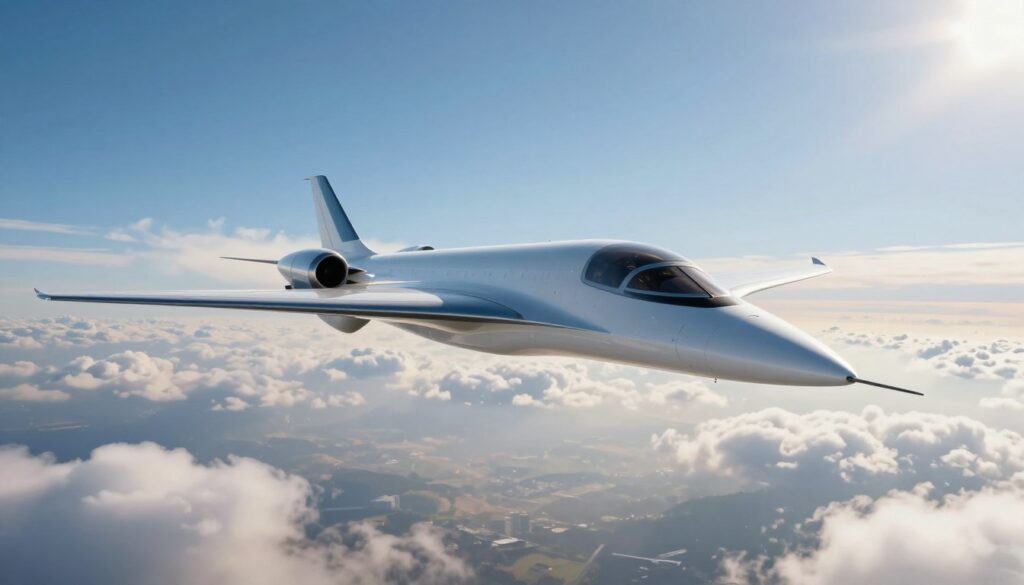
Commercial supersonic aviation is on the verge of a new era, promising to revolutionize air travel with speeds that surpass the sound barrier.
Building on the legacy of the Concorde and the technological advancements of recent decades, companies like Boom Supersonic and Spike Aerospace are developing new supersonic aircraft.
The impact of supersonic aviation on the future of aviation will be significant, allowing passengers to reach their destinations in half the time currently required, having a profound effect on business travel and international tourism, connecting distant markets more efficiently.
With supersonic aviation, the future of aviation looks promising, offering new possibilities and experiences for passengers.