
Anúncios
Have you ever stopped to think about how your suitcase travels through miles of invisible tunnels to reach the correct plane?
This logistical magic happens thanks to modern automated baggage handling systems, ensuring a smooth trip, eliminating human error, and increasing the speed of handling belongings.
Anúncios
Today, we’ll explore the technology behind this impressive flow.
Essential components of an automated baggage handling system
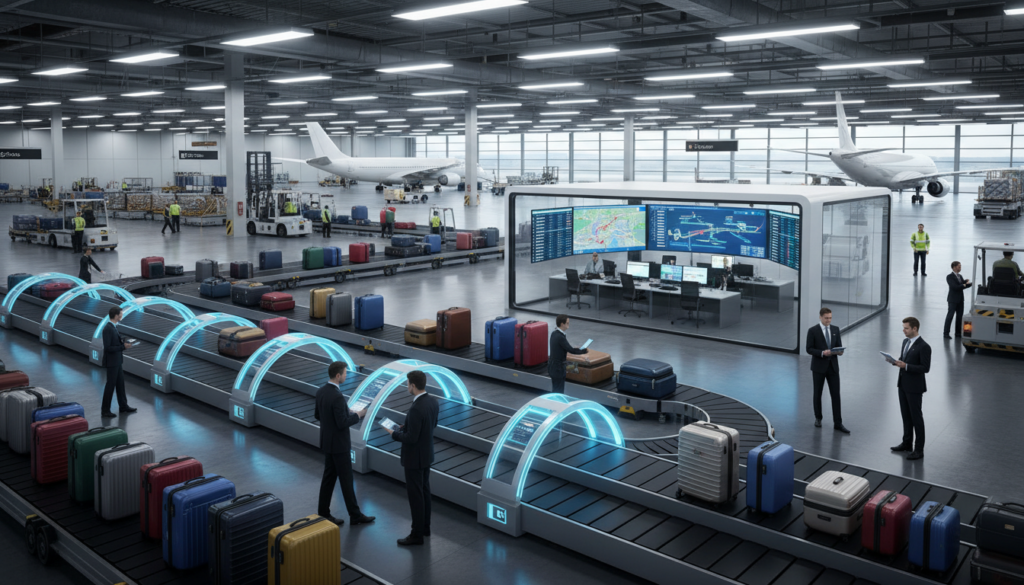
Have you ever wondered how your suitcase travels kilometers of conveyor belts in just a few minutes inside an airport?
The success of this logistics depends on a complete infrastructure, designed to ensure that each item is processed quickly and safely, functioning like a living organism, where each mechanical and digital part plays a vital role.
Anúncios
Conveyor belts and high-speed belts
The heart of the movement in any terminal is the high-performance baggage conveyor belts, responsible for transporting thousands of suitcases per hour, maintaining a constant and organized flow between check-in and the aircraft.
These belts use state-of-the-art motors that adjust their speed according to the terminal’s demand, avoiding congestion and ensuring that waiting time is reduced to the minimum possible.
Proximity sensors and barcode readers
For the system to know exactly where each suitcase should go, it needs attentive “eyes.” Proximity sensors and barcode readers work together to identify each item the moment it enters the sorting line.
This instant reading technology is fundamental for operational precision. Below, we list the components that ensure the efficiency of this process:
- Infrared sensors for volume and position detection.
- High-resolution laser readers for identification labels.
- Programmable logic controllers that manage routing.
- Dynamic weighing systems integrated into the conveyor belts.
The Lifecycle of Luggage at the Airport
The journey a suitcase takes within an airport is a fascinating and highly technological process. It all begins the moment the traveler hands over their belongings for transport, initiating a sequence of precise events.
Check-in and the Application of the Smart Tag
Baggage drop-off is the initial stage where technology takes control. At this point, a smart tag is attached to the suitcase, containing all the necessary information for its journey.
This tag allows for quick and automatic reading at various points in the terminal. Thanks to this system, the chance of manual errors is drastically reduced, ensuring that each item reaches its correct destination.
The Role of Automated Sorting Systems
After registration, the suitcase enters a complex baggage sorting system, using advanced sensors to direct each item to the appropriate boarding gate, maintaining organization at high speed.
Tag reading occurs continuously throughout this process, feeding the central system with real-time data, which is vital to ensure that passenger flow is not interrupted by unexpected operational bottlenecks.
By integrating baggage handling with efficient baggage screening, airports can manage thousands of items simultaneously, ensuring that passenger flow is smooth and stress-free for travelers.
Radio Frequency Identification (RFID) technology
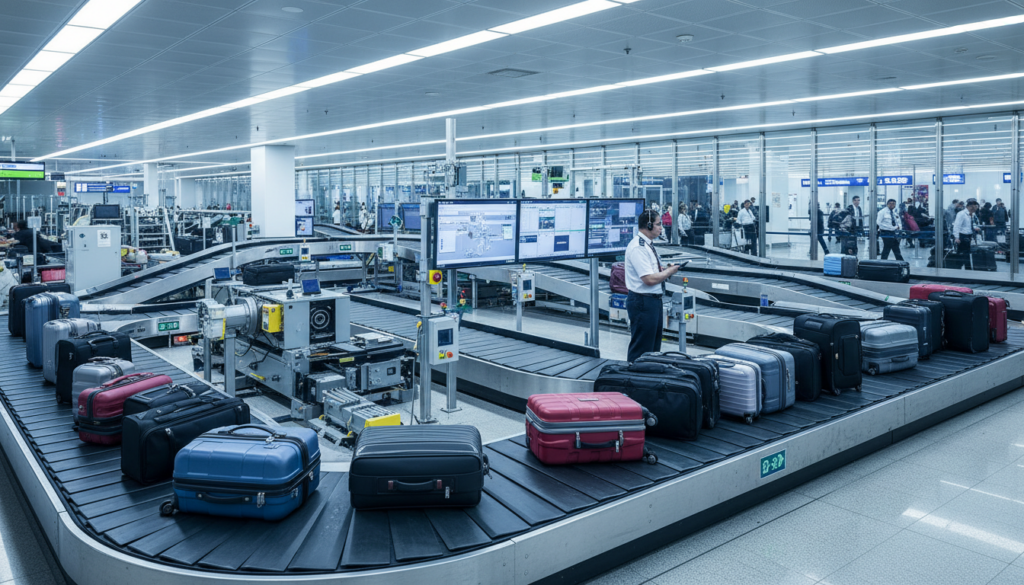
RFID technology is transforming how we handle baggage in modern airports, allowing terminals to automatically and extremely quickly identify items throughout the passenger’s journey.
Unlike older methods, RFID technology uses radio waves to transmit data, creating a much smoother workflow and less prone to serious operational failures.
How RFID surpasses traditional barcodes
The main advantage of this innovation lies in its processing capacity. While barcodes require the reader to have a direct line of sight to the tag, the radio frequency system eliminates this physical barrier.
Tag reading occurs even if the bag is upside down or covered by other objects; that is, hundreds of items can be scanned simultaneously in a matter of seconds.
Benefits for real-time traceability
Bag traceability has become much more precise with the adoption of these smart tags. Airlines now have complete visibility into the location of each piece of baggage, from check-in to loading onto the aircraft.
The main benefits of this implementation include:
- Drastic reduction in lost baggage.
- Increased processing speed at terminals.
- Significant improvement in passenger experience.
- Constant monitoring of baggage traceability.
- Superior efficiency in high-speed baggage tag reading.
High-Speed Baggage Handling Systems
Have you ever wondered how luggage travels enormous distances in just a few minutes at modern airports? The answer lies in the implementation of advanced technologies that ensure a continuous and secure flow, fundamental to maintaining flight punctuality and traveler satisfaction.
The transition from traditional baggage conveyors to more dynamic solutions has allowed terminals to handle much larger volumes.
With the use of automation, handling becomes more precise, reducing the risk of lost or damaged luggage during internal transit.
Individual Transport Vehicles (ICS)
ICS transport systems represent the state of the art in baggage handling. Unlike conventional methods, each bag is placed in an independent vehicle that follows a programmed route to its final destination.
This technology allows the system to intelligently manage traffic, avoiding congestion at critical points.
By using individual vehicles, the airport gains the flexibility to adjust routes in real time, ensuring that baggage arrives at the correct aircraft with absolute precision.
Energy Efficiency in Cargo Transportation
Beyond speed, operational efficiency is maximized through intelligent motors that consume energy only when necessary, designed to enter standby mode when there is no cargo, resulting in significant resource savings.
The adoption of these technologies brings clear advantages to airport management, such as:
- Reduced mechanical wear on internal components.
- Lower electricity consumption during off-peak hours.
- Increased lifespan of baggage conveyor belts.
- Improved overall reliability of ICS transport systems.
The Screening and Security Process
Behind every checked bag lies a complex network of automated checks that ensure peace of mind during the journey.
Modern airport security operates silently, protecting passengers as baggage travels along miles of conveyor belts, essential for maintaining operational efficiency in busy terminals around the world.
Multi-Level X-ray Inspection
Current technology utilizes advanced security inspection systems that analyze the contents of bags at different levels.
Through multi-level X-rays, the equipment can identify suspicious materials with impressive precision, drastically reducing the need for manual intervention.
When an item raises any doubt, the system directs the baggage for a more detailed analysis, occurring in milliseconds, allowing baggage screening to continue flowing without causing bottlenecks or unnecessary delays in passenger boarding.
Integration with National Security Systems
The effectiveness of airport security depends not only on local equipment but also on constant communication with control agencies.
Baggage screening is fully integrated into national data networks, allowing for a fast and secure exchange of information about potential threats.
This connectivity ensures that each bag is checked according to the most rigorous protocols in place.
By centralizing this information, airports can maintain a protected environment, ensuring that security inspection technology works in harmony with the authorities to protect the integrity of all air operations.
Conclusion
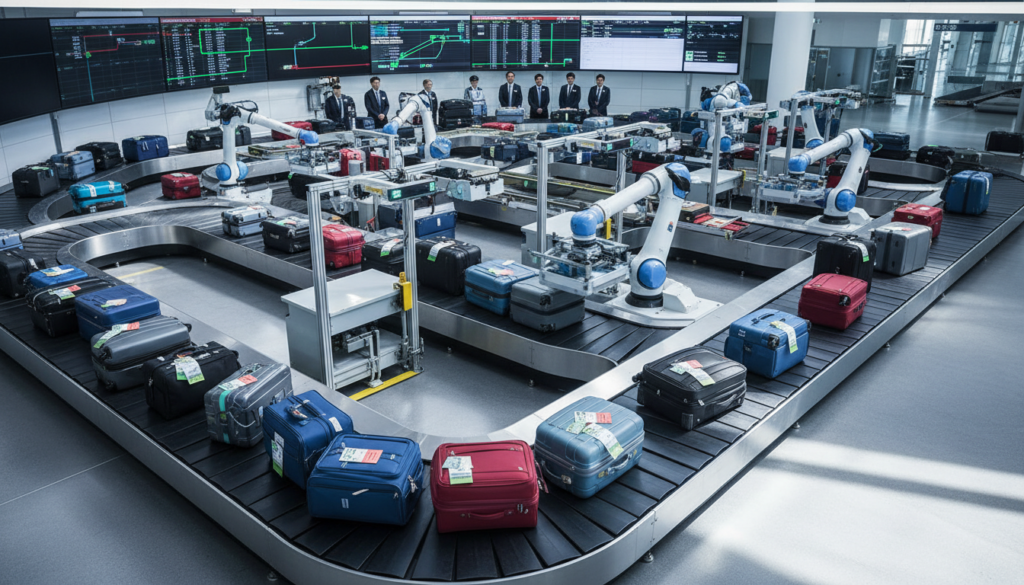
The modern passenger’s journey depends directly on the technological precision applied behind the scenes at terminals, ceasing to be a differentiator and becoming the pillar that sustains the safety and agility of global travel.
The implementation of artificial intelligence allows for the prediction of bottlenecks before they affect flight schedules, promoting a significant reduction in errors and ensuring that each piece of luggage arrives at its destination with absolute precision.
When technology works in harmony with infrastructure, the result is a fluid, efficient experience free from unnecessary worries.