
Anúncios
Have you ever looked at the map of an international flight and wondered why the aircraft seems to take a strange detour near the top of the world? Many people believe this route is just a random choice by the pilots, but the reality is quite different and fascinating.
In fact, this famous detour around the Arctic is a clever strategy that combines geography and physics to make global travel much more efficient.
Anúncios
Today, we’ll demystify this process and show how aviation science transforms what seems like a long way into a practical solution for connecting continents.
Why do some flights detour around the Arctic to save time?
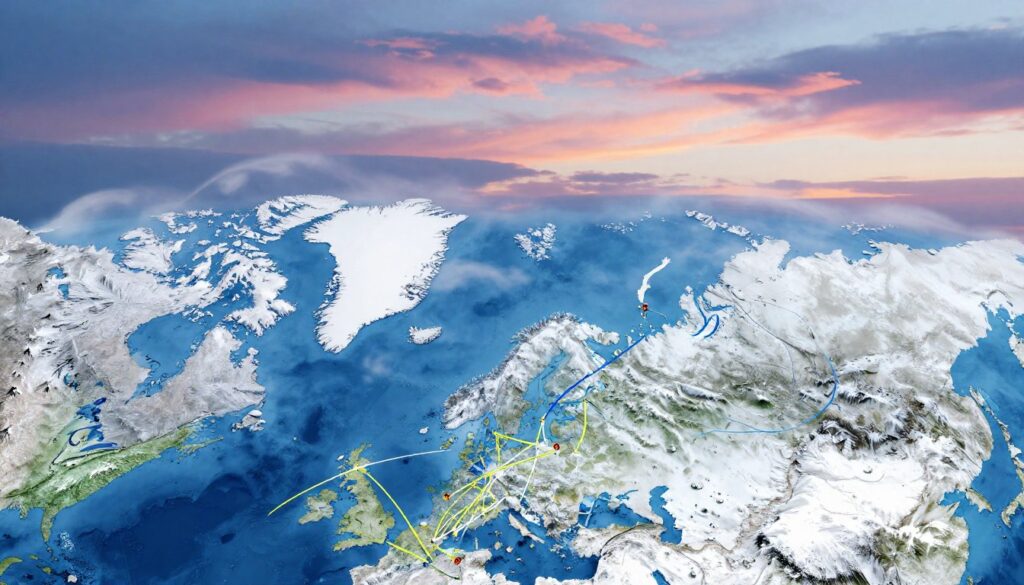
The secret to faster long-distance flights lies hidden in the polar regions. When we observe the globe from above, we realize that the shortest path between two distant points is not always a straight line on a flat map.
By choosing a detour over the Arctic, aircraft can drastically reduce the total distance traveled, which is fundamental for modern international aviation, which seeks to optimize routes to connect continents quickly.
Anúncios
The mathematics of the shortest distance
Spherical geometry explains why these routes are so advantageous. On a sphere, the minimum distance between two points is an arc of a great circle, which often leads planes to pass near the top of the world.
Many transcontinental flights connecting North America to Asia use this mathematical logic. By following this trajectory, pilots avoid the longer path that would be traced on a common two-dimensional map.
Reduced flight time and operational efficiency
The choice of long-haul routes that cross the Arctic brings clear benefits to the operational efficiency of airlines. Less time in the air means smarter use of available resources and a better experience for travelers.
Several factors make this practice essential for the industry:
- Significant fuel savings on intercontinental routes.
- Reduced total travel time for passengers.
- Optimization of global air networks.
- Less wear and tear on aircraft due to shorter flights.
This approach transforms international aviation logistics, allowing transcontinental flights to be carried out more frequently and accurately, ensuring a more sustainable and competitive operation in the global market.
The role of fuel and airline economics
Flight efficiency goes far beyond simply arriving quickly at the final destination. For companies in the sector, the cost of aviation kerosene represents one of the largest portions of the daily operating budget.
By optimizing routes, companies can transform the financial viability of their operations, critical on long-haul routes, where every kilometer reduced directly impacts the company’s financial balance.
Less weight, more efficiency
When an aircraft travels a shorter distance, it naturally needs to carry less fuel to complete the journey, generating a positive ripple effect throughout the logistics operation.
There are several factors that make this practice advantageous for the sector:
- Reduced engine wear due to shorter operating time.
- Fewer refueling stops.
- Optimized payload for passengers and baggage.
- Better fuel economy on transcontinental flights.
Environmental Impact and Carbon Emission Reduction
The pursuit of sustainability in aviation has become a global priority. Less fuel consumption automatically means a smaller carbon footprint for each passenger transported.
Many companies are investing in technologies and smart routes to mitigate climate damage. The use of polar routes is a clear example of how science helps promote long-term sustainability in aviation.
By prioritizing flight efficiency, the aviation sector demonstrates that it is possible to balance profit with environmental responsibility.
Fuel savings on long-haul routes are not only a smart choice for the wallet, but an essential step towards a more conscious future.
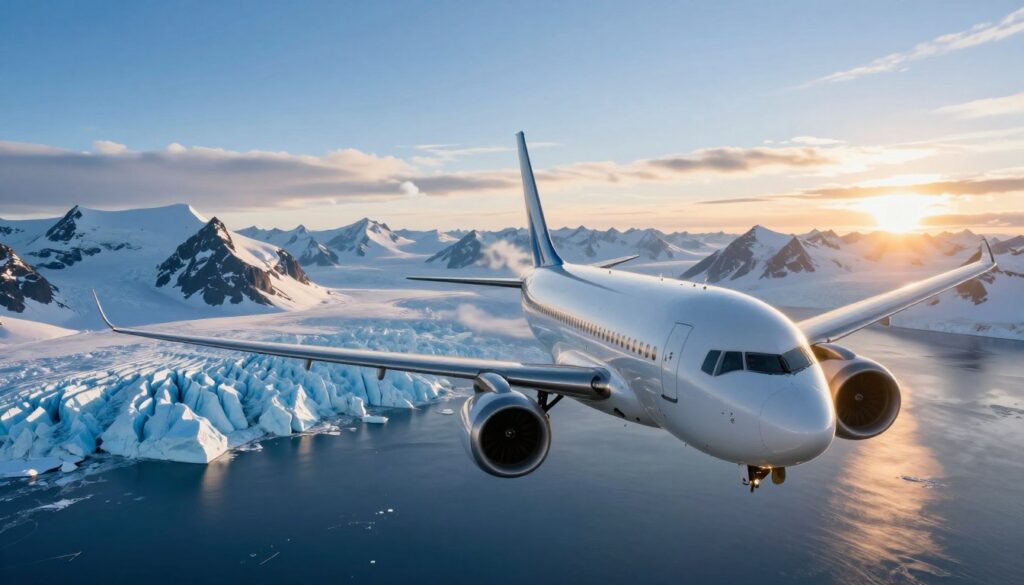
Operational Challenges of Flying Over the Top of the World
Navigating the Arctic skies demands a level of technical precision far beyond what we see on conventional routes.
Flying over remote regions requires a robust technological infrastructure to ensure the safety and constant connectivity of all passengers and crew.
International aviation depends on highly reliable systems to operate in these inhospitable areas. Without adequate support, monitoring flights at such high latitudes would be virtually impossible.
Satellite Communication in Extreme Latitudes
Satellite communication is essential in extreme latitudes, where conventional radio systems frequently fail. The curvature of the Earth creates physical barriers that prevent the efficient propagation of traditional radio waves.
To overcome this obstacle, aircraft utilize cutting-edge technologies that maintain direct contact with control centers, vital for the safety of international aviation throughout the polar journey.
The Importance of Ice Monitoring Stations
Beyond onboard technology, the presence of ice monitoring stations provides crucial data for successful operations, acting as support points that ensure complete control over aircraft in transit.
The main challenges faced by these teams include:
- Equipment maintenance in sub-zero temperatures.
- Precise synchronization of satellite communication with base stations.
- Real-time meteorological data collection to avoid turbulence.
- Ensuring redundancy in the stations’ power systems.
How Extreme Weather Influences Flight Planning
When aircraft cross the Arctic, extreme weather dictates the rules of the game for pilots and ground crews. Flight planning in these regions requires constant weather monitoring, as conditions can change rapidly in isolated areas.
In addition to clouds and winds, specialists need to analyze space phenomena occurring far from the Earth’s surface, ensuring that the aircraft follows the safest and most efficient path possible.
Monitoring Solar Storms and Radiation
Solar storms represent a unique challenge for aviation at high latitudes. When they occur, radiation can directly interfere with onboard electronic systems and the quality of satellite communication.
Therefore, airlines closely monitor solar activity before authorizing any polar route. If radiation levels are high, flights may be diverted to ensure the integrity of equipment and the safety of everyone on board.
The Influence of Jet Streams on Stability
Jet streams are intense winds that circulate at high altitudes and play a fundamental role in air navigation, acting as an extra “push,” increasing aircraft speed and reducing fuel consumption.
On the other hand, flying against these currents requires much more rigorous flight planning to avoid severe turbulence.
The intelligent use of these airflows is what allows the aircraft to maintain stability, making the journey more comfortable and economical even in extreme weather.
Conclusion
The decision to circumnavigate the Arctic represents a fascinating union between advanced physics and the need for operational efficiency. Airlines use these routes to optimize fuel consumption and reduce travel time between distant continents.
Mastering these routes requires constant monitoring, especially in the face of climate change that alters the environmental balance of the region.
Each Arctic circumnavigation is a reminder that technology must go hand in hand with the preservation of the planet. The accumulated knowledge about ocean currents and atmospheric patterns helps to make air transport safer and more sustainable.